

Introduction
Precision is one of the most important requirements in modern industrial automation. Whether it’s a CNC machine, packaging line, robotic arm, or semiconductor assembly system, accurate and repeatable movement is critical for maintaining productivity and product quality.
Linear guides are designed to provide smooth, precise, and low-friction linear motion while supporting heavy loads. They play a vital role in ensuring stability, accuracy, and reliability in automated machinery.
This guide explores the fundamentals of linear guides, their benefits, applications, and how to select the right solution for your automation project.
What is a Linear Guide?
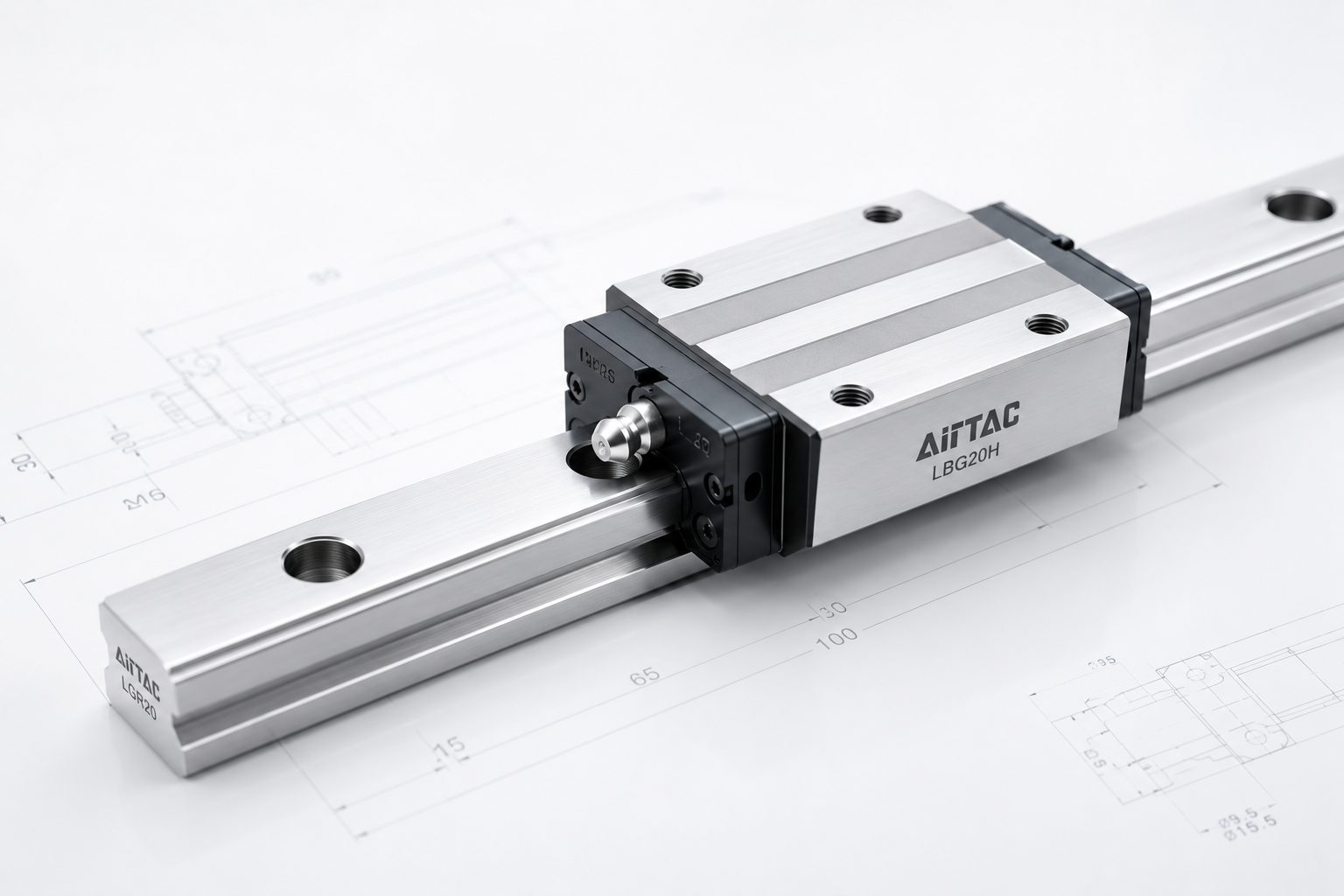
A linear guide is a motion component that allows an object to move smoothly and accurately along a straight path.
A typical system consists of:
- Guide Rail
- Carriage Block
- Ball Bearings or Rollers
- Lubrication System
The carriage moves along the rail with minimal friction, providing controlled and repeatable motion.
Benefits of Linear Guides
High Precision
Linear guides provide excellent positioning accuracy, making them ideal for applications requiring consistent and repeatable movement.
Smooth Motion
Ball-bearing systems reduce friction and enable smooth travel even under heavy loads.
High Load Capacity
Designed to support significant vertical, horizontal, and moment loads.
Long Service Life
Properly maintained linear guides offer years of reliable operation.
Energy Efficiency
Reduced friction results in lower energy consumption and improved machine performance.
Common Types of Linear Guides
Standard Linear Guides
Designed for general industrial automation and machine-building applications.
Low Profile Linear Guides
Compact designs suitable for limited installation spaces.
Miniature Linear Guides
Used in precision equipment and lightweight automation systems.
Wide Rail Linear Guides
Provide additional stability for wider loads and demanding applications.
Industrial Applications
Linear guides are widely used across various industries:
CNC Machines
Deliver precise movement for cutting, drilling, and machining operations.
Robotics
Support accurate movement and positioning of robotic arms.
Packaging Machinery
Enable smooth and reliable product handling.
Electronics Manufacturing
Provide precision movement for assembly and inspection systems.
Material Handling Systems
Improve efficiency in automated transport and positioning applications.
Why Choose AirTAC Linear Guides?
AirTAC linear guides are engineered to provide:
- Smooth Operation
- High Accuracy
- Excellent Load Capacity
- Long Service Life
- Easy Installation
- Reliable Performance
These features make them ideal for modern industrial automation systems.
Conclusion
Linear guides are a critical component in automation systems where accuracy, smooth motion, and reliability are essential. Selecting the correct guide series helps improve machine performance, reduce maintenance requirements, and increase overall productivity.
With a wide range of linear motion solutions, AirTAC offers dependable products for applications ranging from machine building and robotics to packaging and precision manufacturing.
